
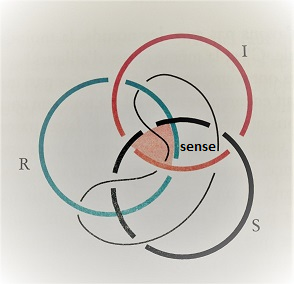
The sinthome, which is not a symptom but rather something like a “mechanism,” an additional link within psychic life, unifies formalization in the realm of art and production with emotional, unconscious life. The sinthome is what, in most cases—often through art—binds meaning; that is, it is the form of production that generates meaning and prevents disintegration, preventing a return to something that would not belong to the order of the creative and the new, but rather to destruction.
This is one of its multiple schemas. (There are the basic registers of human psychic life: the Real, the Imaginary, and the Symbolic, and the closed line labeled “sense,” which is like a sausage, is the sinthome, which binds them together in the case of artists, almost exclusively.)
Natalia Velez
P.h.D. Psychanalyste
Psychologue Clinicienne Hospitalière
P.h.D. Psychanalyste
Psychologue Clinicienne Hospitalière
In Lacan’s later teaching, the sinthome names that aspect of the symptom which cannot be reduced through interpretation or meaning. Unlike the classical symptom—understood as a coded message from the unconscious, capable of being read and eventually dissolved—the sinthome designates an irreducible remainder: it does not speak, it does not signify, it does not resolve. It persists.
The sinthome is, above all, a singular mode of jouissance—an absolutely unique invention through which each subject manages to deal with the Real, with that which finds no symbolic inscription nor stable form in the image. Far from being a flaw that must be corrected, the sinthome functions as an existential solution: a way of sustaining oneself in the world precisely where meaning fails.
At this point, Lacan reformulates the structure of the subject on the basis of the Borromean knot, where the Real, the Symbolic, and the Imaginary remain linked only if no ring comes undone. The sinthome thus appears as a fourth tie, not to provide meaning, but to ensure the consistency of the whole. When the knotting among the registers falters, the sinthome operates as a support, as that which holds together what would otherwise come apart.
The sinthome is, ultimately, the unrepeatable way in which a subject knots themselves to their existence: not what gives meaning, but what allows something to hold together.
Statement
This artist residency program is grounded in the notion of the sinthome, developed by Jacques Lacan in 1975–1976, understood not as a symptom to be interpreted but as a singular mode of doing.
The residency offers a space-time in which to inhabit that which insists, to work with error, failure, and opacity as constitutive dimensions of artistic practice. The sinthome is not conceived here as practical knowledge, but as a way of sustaining practice where meaning does not close.
The program is structured as a dispositif of accompaniment and listening. The aim is not to interpret the subject, but to sustain processes, allow for drift, and accompany the emergence of singular knotting among body, language, matter, and thought.
During the residency, priority is given to practices of reiteration, procedures sustained over time, self-imposed limitations, and work with remnants, fragments, or minimal actions. Artistic research is understood as an exercise in insistence, and the value of the process is placed above any result.
The residency culminates in a non-conclusive presentation instance: process-based showings, activations, readings, open archives, or fragmentary publications. These moments do not function as a closure or a synthesis, but rather as a temporal cut — a pause that makes the work visible without suturing it.
This program is aimed at artists whose practice is built from questioning, discomfort, or repetition; at those who work from what does not quite function, yet continues to produce thought, gesture, and form. Completed projects or defined objectives are not required, but rather a willingness to sustain one’s own practice where meaning becomes unstable.
More than a production residency, this program proposes a space to practice the irresolvable, to work with what is at hand, and to affirm singularity as an ethical condition of contemporary artistic practice.
The sinthome is, above all, a singular mode of jouissance—an absolutely unique invention through which each subject manages to deal with the Real, with that which finds no symbolic inscription nor stable form in the image. Far from being a flaw that must be corrected, the sinthome functions as an existential solution: a way of sustaining oneself in the world precisely where meaning fails.
At this point, Lacan reformulates the structure of the subject on the basis of the Borromean knot, where the Real, the Symbolic, and the Imaginary remain linked only if no ring comes undone. The sinthome thus appears as a fourth tie, not to provide meaning, but to ensure the consistency of the whole. When the knotting among the registers falters, the sinthome operates as a support, as that which holds together what would otherwise come apart.
The case of James Joyce occupies a paradigmatic place here. For Lacan, Joyce’s writing is not sublimation in the classical sense, but his sinthome: a singular practice that compensates for a structural flaw and allows him to sustain himself as a subject. Joyce did not interpret his symptom nor seek to cure it; he wrote it, pushed it to the limits of language, turned it into form, into style, into artifice. He made of his sinthome a know-how.
In this way, the ethics that emerges from the sinthome does not aim at normalization or the elimination of suffering, but at the possibility of assuming what is one’s own, of recognizing that singular mode of jouissance and finding a viable way to inhabit it. Analysis does not lead to the disappearance of the sinthome, but to a different relation to it: less subjected to suffering, closer to an invention.The sinthome is, ultimately, the unrepeatable way in which a subject knots themselves to their existence: not what gives meaning, but what allows something to hold together.
Statement
This artist residency program is grounded in the notion of the sinthome, developed by Jacques Lacan in 1975–1976, understood not as a symptom to be interpreted but as a singular mode of doing.
The residency offers a space-time in which to inhabit that which insists, to work with error, failure, and opacity as constitutive dimensions of artistic practice. The sinthome is not conceived here as practical knowledge, but as a way of sustaining practice where meaning does not close.
The program is structured as a dispositif of accompaniment and listening. The aim is not to interpret the subject, but to sustain processes, allow for drift, and accompany the emergence of singular knotting among body, language, matter, and thought.
During the residency, priority is given to practices of reiteration, procedures sustained over time, self-imposed limitations, and work with remnants, fragments, or minimal actions. Artistic research is understood as an exercise in insistence, and the value of the process is placed above any result.
The residency culminates in a non-conclusive presentation instance: process-based showings, activations, readings, open archives, or fragmentary publications. These moments do not function as a closure or a synthesis, but rather as a temporal cut — a pause that makes the work visible without suturing it.
This program is aimed at artists whose practice is built from questioning, discomfort, or repetition; at those who work from what does not quite function, yet continues to produce thought, gesture, and form. Completed projects or defined objectives are not required, but rather a willingness to sustain one’s own practice where meaning becomes unstable.
More than a production residency, this program proposes a space to practice the irresolvable, to work with what is at hand, and to affirm singularity as an ethical condition of contemporary artistic practice.
1. For Lacan, jouissance is the paradoxical and excessive satisfaction of the drive, which operates beyond the pleasure principle and is often experienced as discomfort or pain. Unlike pleasure, which seeks to reduce tension, jouissance overwhelms bodily limits and is linked to the impossible, the unconscious, and symptomatic repetition.
2. In Lacan, sublimation—defined as the operation that elevates an object to the dignity of the Thing—should not be confused with the sinthome. Whereas sublimation operates primarily in the field of the Other (reordering the status of the object and its symbolic inscription), the sinthome names a singular and irreducible mode of knotting between the Real, the Symbolic, and the Imaginary. If sublimation skirts the structural void of desire without attempting to fill it, the sinthome constitutes the idiosyncratic form through which each subject deals with that void—not in order to elevate an object, but to sustain their subjective consistency where meaning fails. At this point, one may say that every effective sublimation relies, unknowingly, on a sinthome: not as an ideal, but as an opaque support of jouissance that allows the void neither to be closed nor to unravel the subject.